
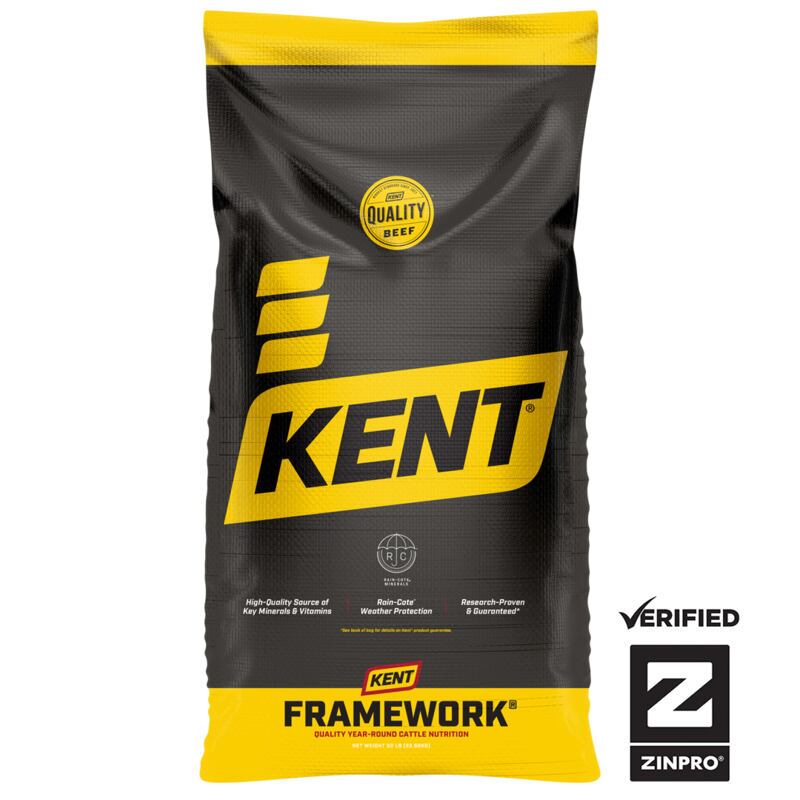
Framework 365 Mineral Performance Co-Product Balancer
| Life Stage: | Cow/Calf, Heifer |
|---|---|
| Feed Type: | Vitamin or Mineral |
| Feed Form: | Meal |
| Packaging: | 50-lb Bag |
Supplementing cattle with corn co-products comes with unique advantages and challenges. The advantage is a highly palatable, high protein (by-pass) supplement that is relatively inexpensive. The challenge is maintain proper macro and micro trace mineral nutrition, as corn co-products are very high in phosphorus and can be high in sulfur. Providing a mineral specifically formulated to address the challenges presented by feeding corn co-products is essential to keep cattle performing optimally. Framework 365 Mineral Performance Co-Product Balancer Availa®4 is formulated with additional calcium and thiamine, and no added phosphorus, to balance the diet of cattle consuming corn co-products while grazing.
This mineral is formulated to provide 7 g of Availa®4 when consumed at 4 oz. Availa®4 is research proven to positively impact reproductive performance in beef cattle. The amount consumed will vary depending on the quality, type and quantity of feedstuffs available.
- Availa®4 - Availa®4 amino acid trace mineral complexes offer trace mineral supplementation in a form that is highly bioavailable to the animal and are research proven to improve reproductive performance in cattle.
- Calcium and phosphorus - This product is formulated without added phosphorus, as corn co-products are high in phosphorus. Instead, calcium is added at a higher rate compared to Framework 365 Mineral ADE to help balance the phosphorus provided by the corn co-products.
- Optimal mineral fortification - Formulated to exceed NRC recommendations for trace minerals, helps overcome antagonists and support optimal animal health and performance.
- Optimal vitamin fortification - Vitamins A, D and E support growth, metabolism, reproductive performance and proper immune system function.
- Added Thiamine - Corn co-products can bring additional sulfur to the total diet, which can interfere with thiamine synthesis by the rumen microbes. Providing supplemental thiamine can help prevent deficiencies.
- Highly palatable - A mineral does no good if cattle won't eat it. Addition of salt and other highly palatable ingredients keep cattle seeking out the mineral feeder.
- Rain-Cote - Reduces loss of mineral exposed to wind and weather, improves water resistance and reduces 'bricking-up' in wet weather.
| Calcium, min | 22.70% |
| Calcium, max | 27.20% |
| Phosphorus, min | 0.05% |
| Salt, min | 13.50% |
| Salt, max | 16.20% |
| Magnesium, min | 1.00% |
| Potassium, min | 0.15% |
| Copper, min | 1,500 ppm |
| Manganese, min | 5,200 ppm |
| Selenium, min | 26.4 ppm |
| Zinc min | 5,000 ppm |
| Vitamin A, min | 380,000 IU/lb |
| Vitamin D3, min | 100,000 IU/lb |
| Vitamin E, min | 375 IU/lb |
Hand-feed Framework 365 Mineral Performance Co-Product Balancer in a dry, clean bunk or mineral feeder. The amount consumed will vary depending on the quality, type and quantity of feedstuffs available. Cattle should consume approximately 4 ounces per head per day.
For additional feeding directions, contact your Kent Nutrition Group feed representative.
NutriVantage® Nutrition Optimizer®
NutriVantage Nutrition Optimizer is an exclusive research-driven nutritional feed supplement that is only available in Kent/Blue Seal products.

Related Resources
Why Your Neighbor’s Cattle Fly Program Shouldn’t Dictate Yours
Reprinted with permission from Angus.com Fly control conversations among beef producers often circle back to the same question: “Why invest in fly control if my neighbor isn’t doing anything?” If flie …
Read MoreCorn Residue Grazing As a Forage Option for Beef Cattle
How much corn residue is available for grazing? On average, there are 16 pounds of husks and leaves left behind per bushel of corn per acre post-harvest. If the average yield of a cornfield is 150 bus …
Read MoreFeeding Cross Calves for Beef-on-Dairy Top Performance
The only caution of crossbreeding programs beef-on-dairy operations is the utilization of the Jersey breed. Jersey-beef cross calves may have reduced gains compared to their Holstein-beef cross counte …
Read More