
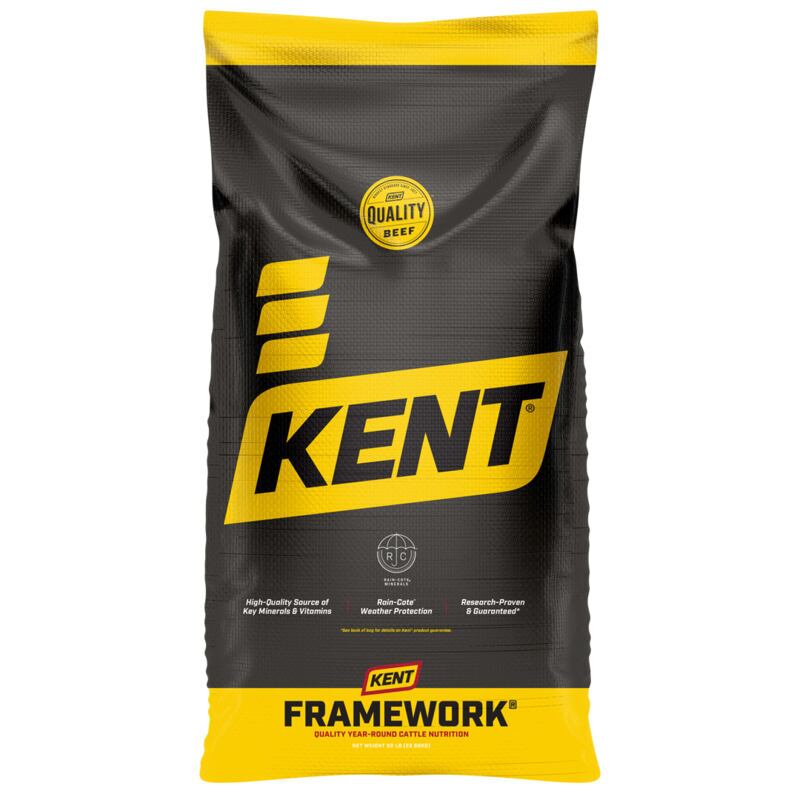
Framework 365 Mineral Mid-Atlantic ADE AFC
| Life Stage: | Cow/Calf, Heifer |
|---|---|
| Feed Type: | Vitamin or Mineral |
| Feed Form: | Meal |
| Packaging: | 50-lb Bag |
Framework 365 Mineral Mid-Atlantic ADE AFC Mineral is a free-choice, loose mineral supplement formulated for beef cattle on pasture.
- 10% magnesium - Provides 11 g of magnesium at 4 oz intake to aid in the prevention of grass tetany.
- Trace minerals and vitamins - Formulated to provide trace minerals and vitamins to help support optimal animal health and performance.
- Highly Palatable - A mineral does no good if cattle won't eat it. Addition of salt and other highly palatable ingredients keep cattle seeking out the mineral feeder.
- Altosid Fly Control - Horn flies cost the cattle industry billions each year in lost milk production, lost calf gains, and lost cow performance. An integrated fly control program, including Altosid, can keep horn fly populations at bay.
| Calcium, min | 15.00% |
| Calcium, max | 18.00% |
| Phosphorus, min | 2.00% |
| Salt, min | 13.50% |
| Salt, max | 16.20% |
| Magnesium, min | 10.00% |
| Potassium, min | 0.15% |
| Copper, min | 1,500 ppm |
| Manganese, min | 5,000 ppm |
| Selenium, min | 26.4 ppm |
| Zinc min | 5,400 ppm |
| Vitamin A, min | 285,000 IU/lb |
| Vitamin D3, min | 28,500 IU/lb |
| Vitamin E, min | 285 IU/lb |
| Active Drug Ingredient | Amount |
|---|---|
| S-Methoprene | 0.01% |
Feed this product to cattle only. When used as directed, this product will provide sufficient S-methoprene insect growth regulator to prevent the emergence of adult horn flies from manure of treated cattle. Existing adult horn flies will not be affected. Start feeding before horn flies appear and continue use until cold weather marks the end of the horn fly season. Allow free choice to cattle. Cattle should consume an average of 0.286 ounces of this product per 100 lbs. of cattle body weight per day, which is equivalent to 4 ounces per day for a 1,400 pound cow.
- Assure cattle are not starved for nutrients in this product by providing them prior to feeding this product.
- This product contains added copper. Do not feed to cattle in close proximity to sheep or other species that have a low tolerance to supplemental copper.
- Offer cattle 50 pounds of this product for every 15 head of cattle.
- Remove all other self limiting nutritional supplements while the cattle are consuming this product.
- Locate this product where cattle congregate (watering, loafing, shade areas).
- Replenish this product on a regular basis as needed.
- If intake of this product is below 0.4 ounces per 100 lbs. cattle body weight per day, increase the number of feeding locations and/or change location(s) to areas more frequented by cattle.
- If intake of this product is above 0.4 ounces per 100 lbs. cattle body weight per day, reduce the number of feeding locations and/or change location(s) to areas less frequented by cattle.
- Introduction of this product after adult horn fly infestation is established will require treatment of cattle with adulticides if elimination of the adult fly population is desired.
Warning
See product label for precautionary and warning statements.
Related Resources
Milk Replacer Mixing: Why Consistency Matters for Calf Nutrition
How early weaning strategies and targeted nutrition set calves up for long-term performance.
Read MoreReceiving Calf Nutrition: Building the foundation for health, growth and performance
Learn how receiving calf nutrition, water, feed intake and consistent management can support calf health, growth and performance.
Read MorePrecise Nutrition for Early Weaned Calves
How early weaning strategies and targeted nutrition set calves up for long-term performance.
Read More