Weeks before Cricket was born, tensions were high at Twin Oaks Farm in Ocala, Florida. Tracy Bryant and her mother, Terry, had been watching their 19-year-old broodmare Josie closely, and something wasn’t right. What should have been a routine pregnancy had slowly turned into a growing concern.
Josie began showing soreness in her front feet late in the fall. What initially seemed minor steadily worsened, and on some days she could barely move. Veterinarians and farriers examined her multiple times, taking X-rays and checking for laminitis or injury, but no clear cause emerged.
Then, weeks before her due date, Josie began showing signs of early labor. Night after night, Tracy and Terry monitored the cameras in the barn. Josie would lay down, roll, pace the stall, push against the walls, every sign suggesting that the foal might arrive far too early. Each time, the behavior would subside, leaving them unsure what would happen next.
“We stayed up literally 24 hours watching her,” Tracy recalled.
A premature foal birth
After weeks of monitoring Josie around the clock, the night finally came when their fears became reality. Terry went down to the barn to check on Josie. When she opened the door, she immediately knew something was wrong. In the middle of the stall was a small, motionless foal tangled in the placenta and afterbirth. Cricket had been born, but she wasn’t moving.
“She was just a pile in the middle of the stall,” Terry recalled.
She went back up to the house, to wake Tracy. “Josie had her baby,” she told her. “And it’s not good.” Tracy threw on a bathrobe, and they hurried back to the barn together, unsure of what they would find.
The tiny foal lying in the stall was barely alive. She wasn’t breathing, and her body was cold to the touch. Tracy and Terry grabbed towels and blankets and began rubbing her desperately, trying to stimulate breathing and circulation. For nearly forty minutes they worked, unwilling to stop. Finally, there was movement. Then a breath. The foal was alive, barely.
Cricket weighed only 57 pounds, about half the size of a normal newborn foal. She was weak, premature and showed little awareness of her surroundings. Even worse, she had no instinct to nurse.
Saving a dummy foal
When the veterinarian arrived, his assessment was blunt. Cricket appeared to be what horse owners call a “dummy foal,” a condition where neurological dysfunction prevents normal behavior after birth.
The vet looked at Tracy and warned her not to get attached. He didn’t expect the foal to survive the night.
Tracy and Terry were not ready to give up; they focused on doing whatever they could to keep Cricket alive. They tried to get her up to nurse, but Cricket showed no real desire. They managed to get a small amount of colostrum from Josie, which they fed to Cricket with a syringe.
Even when Cricket did show an interest in nursing, it became clear she was not getting enough. She also refused the milk replacer when it was offered by bottle, further complicating efforts to support her. At that point, the situation shifted from a critical birth to a fight for nourishment. Keeping her alive was no longer just about getting her through those first breaths. It was about finding a way to get nutrition into a foal that could not nurse normally, and whose mother was not producing what she needed.
The Madigan squeeze
At one point, desperate for ideas, Tracy called a trusted horse professional for advice. The suggestion was to try something called the Madigan Squeeze, a technique used to help reset neurological function in compromised animals. She watched a video on how to do it and decided to try. The process lasted twenty minutes. When they released the pressure, something incredible happened.
Cricket jumped to her feet, whinnied and ran toward her mother. It was the first real sign that she might survive. “I looked at my mom and said we’re going to fight for her as long as she wants to fight,” Tracy said.
Feeding a premature foal
But Cricket still wasn’t getting the nutrition she needed. Her mother had stopped producing milk, likely due to her declining health, milk replacer wasn’t working and syringe feeding was messy and exhausting.
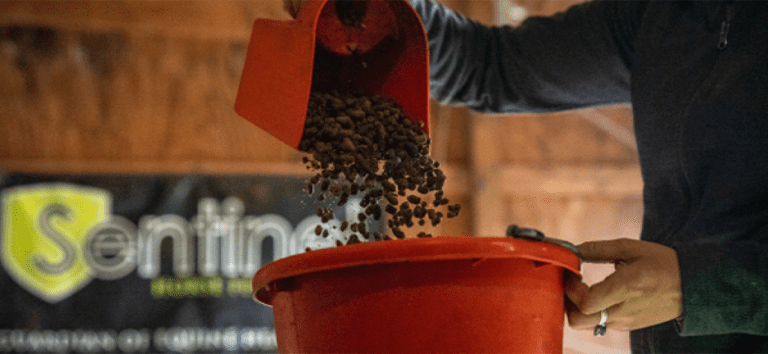
By the third morning of Cricket’s life, they were running out of options. That was when something unexpected happened. Tracy walked into the stall carrying a small bucket of Sentinel Safe Start. Cricket wandered over and began nosing and playing in the feed. At first Tracy didn’t think much of it. But then the tiny foal did something no one expected; she started gumming the feed.
Cricket didn’t have teeth yet, but because Sentinel Safe Start is extruded, it is easily softened and highly digestible, so she was able to mash the nuggets with her gums. For the first time since she was born, Cricket had found a way to get nutrition on her own.
Over the next several hours she kept going back for more. And soon developed her own routine. She would take a mouthful of feed and dunk it into milk replacer to soften it even more before swallowing. Tracy jokingly called it her version of “milk and cookies.”
Within twenty-four hours of eating the feed, Cricket began to change. She became more alert. She started trotting around the stall, bucking and playing like a normal foal. Each day her energy increased as she continued eating the feed, and Tracy and Terry felt genuine hope.
How cricket got her name
About a week later, they brought Cricket outside to the paddock for the first time. The foal stood quietly for a moment, looking around at the new world in front of her.
Then suddenly she exploded into motion. She ran, spun and bounced across the grass on her long, awkward legs. “She looked like a little cricket jumping everywhere,” Tracy said. In that moment, the foal found her name, Cricket.
Raising an orphan foal
While Cricket slowly grew stronger, Josie’s condition continued to worsen. Eventually Tracy and Terry faced the heartbreaking decision to let her go. Losing Josie was devastating, but by then Cricket had developed an extraordinary bond with the people who had fought to save her. Tracy and Terry spent so many hours caring for her that Cricket saw them as her family. To this day she still greets people by sucking on jackets, shirts and shoelaces, a comforting behavior she developed when she was too young to nurse properly.
Cricket and the Sentinel feed bag
Cricket also developed a unique attachment to something else in the stall: a Sentinel feed bag. They first started using a Sentinel feed bag to keep her hay off the stall floor. Tracy would toss a small amount of hay onto the bag and put it in the stall. One day, Cricket wandered over and began nosing the bag itself, tugging on it and playing with it. Before long, she claimed it as her own. She would drag it around the stall, run with it and eventually curl up to sleep on it. Terry started calling it her “feed bag friend.” For months, the bag stayed in the stall with her, and it even rode along in the horse trailer when she traveled, serving as a small comfort from the days when she was fighting just to survive.
From premature foal to show horse
Despite the odds stacked against her from birth, Cricket continued to grow stronger. Within weeks she began catching up in size. Within months she had transformed from a fragile, premature foal into a beautiful young horse with muscle, shine and energy.
And eventually she did something no one expected. She became a show horse.
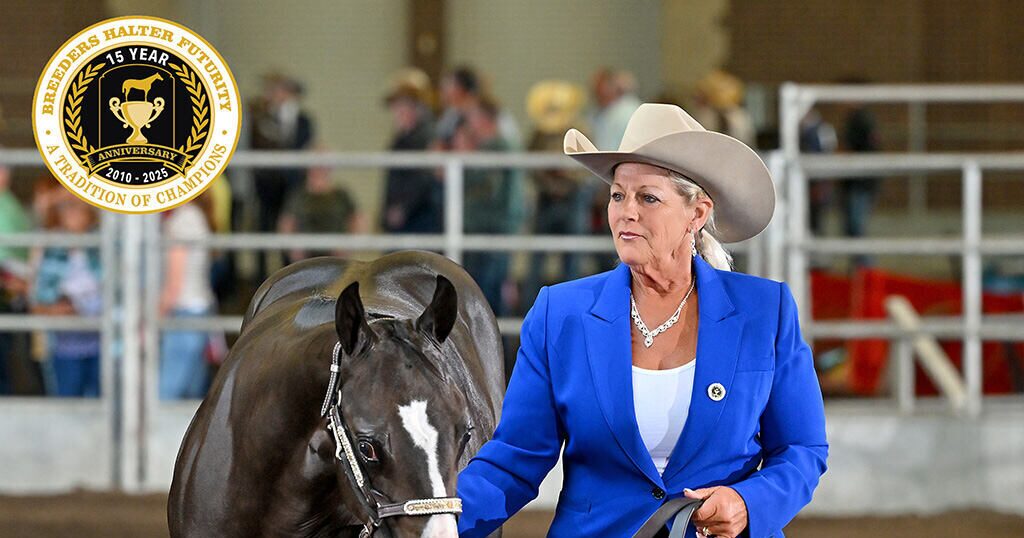
Cricket went on to compete at the prestigious Breeders Halter Futurity and even earned money in the show ring, a remarkable accomplishment for a horse who had once been given less than a day to live.
Lessons from a premature foal
Looking at her today, it’s hard to imagine how close she came to never seeing the world at all. Her story now inspires horse owners far beyond Twin Oaks Farm. People regularly reach out to Tracy after hearing about Cricket’s journey, asking for advice or simply sharing how the story gave them hope during difficult moments with their own animals.
For Tracy, the lesson Cricket taught is simple. “If there’s even a tiny bit of will to live, you don’t give up,” she says.
Because sometimes the smallest fighters become the strongest survivors. And sometimes the foal that wasn’t supposed to live becomes the horse who inspires everyone around her.